
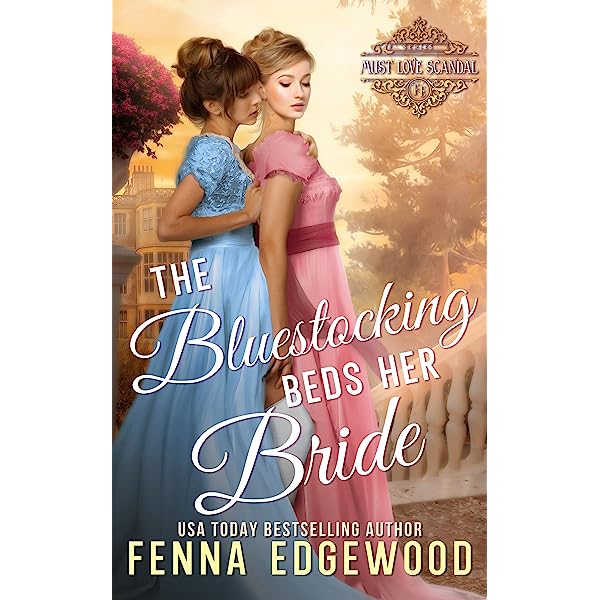
“The Bluestocking beds her bride” by Fenna Edgewood is book #4 from the “Must love scandal” series. It is a historical age-gap opposites attract lesbian romance novel set in 1827, London involving Lady Julia Pembroke and younger Fleur Warburton.
The meaning of the title:
“The term bluestocking was first used in the 18th century to refer to a group of English women who decided they’d rather have intellectual conversations with educated guests than sit around playing cards and chatting. Because at least one of their guests wore inexpensive, blue worsted stockings, people who disapproved started calling these ladies bluestockings. They quickly reclaimed the term, happily calling their group “The Blue Stockings Society.”
Before feminism gained momentum in the late nineteenth and twentieth centuries, there was the Bluestocking Society, an eighteenth-century literary group run by aristocratic and brilliant women of the day.
Often defined as radical for being the first female-led group to champion the careers of other women, in many ways the group was, in fact, rather conservative in its initial aims.
The Bluestockings defined themselves by what they were not, standing against the debauched hedonism of eighteenth-century high society that encouraged excessive drinking, gambling, and idle tittle-tattle. They regarded themselves as virtuous proponents for the art of refined and intellectual conversation, usually over tea drinking.
But why did the Bluestockings become a pejorative term by the late eighteenth century? And moreover, why has the group, regarded by some as the foremothers of modern feminism, been so overlooked?
When the Bluestocking Society was initially founded in the 1750s, its members represented a new kind of modern, intellectual women, who were accomplished and well-versed in many fields – artistic, literary and political.
The art of ‘rational’ conversation was one of the principal aims of the Bluestockings. But what did ‘rational’ mean in the eighteenth-century context?
A product of Enlightenment thought, to be ‘rational’ referred back to the philosophical enquiries of classicism and the Renaissance. In the eighteenth century, the classical world was idealized. The art of refined, intellectual and rational conversation was about more than just proper and polite sociability. It was regarded as a form of moral improvement, a way of promoting ‘civic virtue’. The Bluestockings were fighting against social norms amongst aristocratic circles – gossip and shallow conversation stereotypically attached to women at that time.”
https://www.vocabulary.com/dictionary/bluestocking
https://artuk.org/discover/stories/who-were-the-bluestockings
Lady Julia Pembroke is in her forties and stopped caring what the world thinks of her.
She was believed to be a rare diamond when she was introduced in the London high society, but now she is seen as a spinster and a bluestocking (rumored to sexually prefer women). She has the Violet Manor and her six adopted children, coming from unfortunate homes and she has the Society and the school, were she and other high class ladies like Lady Cooley help women and children who come from abusive homes or poor backgrounds.
She is a beautiful, strong, independent and caring woman who has more than just one Sapphic friends and she is really out and proud considering this is 1827, London .

Recently, her lover Helena announces she is getting married to a man, because she doesn’t wish to be left on the shelf and they both realize they haven’t been really in love with each other. Julia is not happy, but life goes on.
Her longtime friend and Society creator, Lady Cooley passes away and she needs more people to help at the Society. Here come in to the rescue, Fleur Warburton and Jasper Lennox, to help Julia as teacher at the Society. Jasper does an awesome job, but Fleur has no inclination as tutoring children, yet after a hasty, yet fulfilling talk between Julia and her, they decided to find her something else to do at the Society.
Fleur Warburton comes from a village where she hardly escaped a forced marriage that her dead father arranged, she has to send her mother to an asylum and she has a strong desire for revenge against Harcourt Laird, thus she trains at knife throwing.
Lady Julia and Fleur discover they both have a problem with Harcourt Laird, when he comes in the Society and proposes marriage to Julia to help him have a great façade In front of the London society and she strongly refuses and he threatens her, she will tell the world her secret and, especially, because Julia knows Fleur has been in the same carriage when his son died.
Harcourt Laird (is a man of the Black Lodge) who has done terrible things to less fortunate women and children and wants redemption.
And, also, Julia shared really fast that she prefers women to men, while after some time, Fleur also admitted to the same.
I feel that the plot is a little rushed here and they become close really fast.
They are opposites attract, Julia is calm, strong and beautiful, while Fleur is grumpy and fast to anger, however, also stunning in her own way.
I enjoyed their intimacy and their lovemaking and the communication between them, especially at the cottage, when Julia convinces Fleur to open up. And, I wanted them to have more time to discover themselves.

The development of the plot is quite amazing and interesting, and the two women get into a lot of trouble, trying to save the innocent.
I liked the side characters, even though they had history in previous books: Lady Gemma de la Croix (I loved her Sapphic parties), Cherry, the Duchess of Crossley, Miss Laura Crosby, Miss Jane Pike, even the villains, Harcourt Laird and Lady Ashe.
I enjoyed that Jasper Lennox and David Cohen develop a relationship.
The author managed to capture the language of the era and I found the characters’ debates quite revealing.
This is a gem for historical lesbian romances lovers.


 Inkmarksonemptydreams