
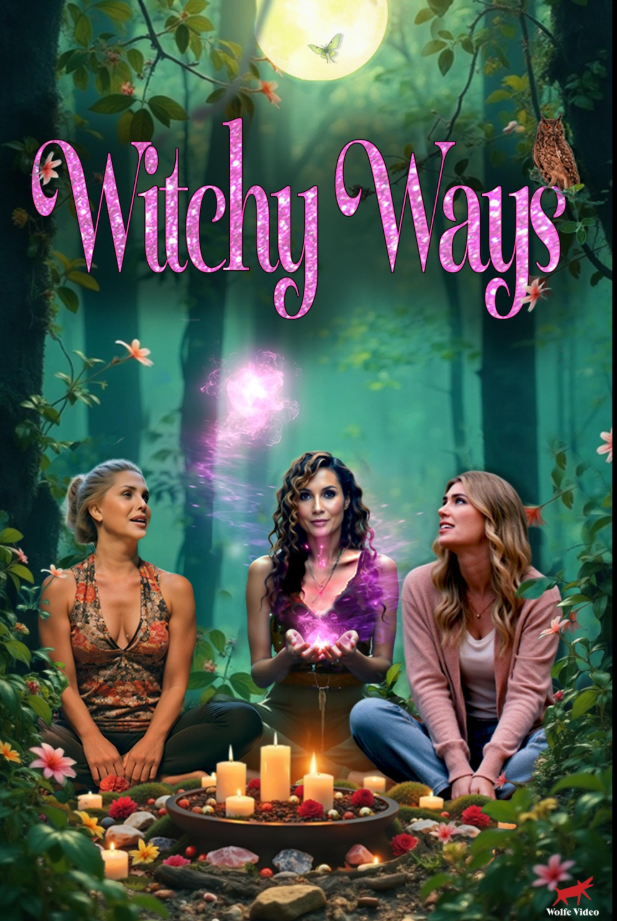
I didn’t expect Witchy Ways to break me open the way it did.
I went in expecting a cozy supernatural romance—something warm and witchy to curl up with, a gentle escape. What I got instead was a mirror held up to every time I’ve ever been afraid to be fully seen, every moment I’ve chosen safety over truth, every relationship where I’ve dimmed my own light to make someone else more comfortable. This film doesn’t just tell a love story. It asks what we’re willing to sacrifice to live authentically, and whether we have the courage to believe in something beyond what we can control.
At its heart, Witchy Ways follows Eve, a high-powered brand manager whose world is built on logic, metrics, and carefully managed outcomes. When she retreats to her late mother’s cottage—a place whispered about in the community as magical—she meets Danni, her enchanting neighbor who comes from a long line of witches. Their connection unfolds with the kind of tender inevitability that feels both surprising and cosmically right. Eve, armored in skepticism and grief, begins to soften. Danni, radiant in her power and vulnerability, shows Eve what it means to live without apology.
What gutted me most wasn’t the magic itself—though the film handles witchcraft with reverence and authenticity that feels revolutionary. It was watching Eve struggle against her own desire for connection, watching her logic war with her heart. Because haven’t we all been Eve at some point? Haven’t we all stood at the precipice of something real and terrifying, something that would require us to shed the protective layers we’ve built, and felt that pull to retreat into what’s familiar and safe?
The parallels between modern witchcraft and queer experience run through this film like veins of gold. Both communities have been misunderstood, marginalized, forced into hiding. Both require courage to claim openly. Director Jane Clark doesn’t beat you over the head with this—she trusts you to feel it. When Danni’s home and legacy face threats from a vengeful neighbor, it’s not just about saving a house. It’s about the right to exist as you are, to practice your truth, to love without apology.
The chemistry between Diora Baird and Marem Hassler is electric in its subtlety. There’s a scene where they’re having breakfast, and Danni kisses Eve so casually, so naturally—like this is just what they do now, like love has already rooted itself between them without either of them quite noticing. I rewound that moment three times. Not because it was dramatic or cinematic in the traditional sense, but because it captured something so rare in queer cinema: the quiet domestic magic of being known and loved exactly as you are.
And can we talk about how this film treats its queer romance not as a statement or a struggle, but simply as a romance? Eve and Danni’s biggest obstacles aren’t their genders or society’s judgment—they’re Eve’s grief, her fear of loss, her inability to trust in things she can’t quantify. This is what queer storytelling should be: not making queerness the conflict, but allowing queer characters to have the same complex, universal struggles as anyone else.
The supporting cast adds layers of depth and representation that feel intentional rather than performative. Candis Cayne—the first transgender actress to land a recurring primetime role—brings gravitas and warmth. The ensemble doesn’t just surround the leads; they create a world where different kinds of magic, different ways of being, coexist and strengthen each other.
But here’s what really destroyed me: the film’s treatment of Eve’s mother and her Alzheimer’s diagnosis. Director Jane Clark drew from her own experience of watching her scientist mother lose her memory but never lose her essential self—her love of birds, her wonder at the natural world. In Witchy Ways, Eve carries the regret of never truly knowing her mother before it was too late, of never asking the questions that mattered. When she begins to open herself to Danni, to magic, to possibility, she’s not just falling in love. She’s reclaiming a connection to her mother, to herself, to the parts of her that logic tried to explain away.
There’s a moment late in the film when Eve must decide: stay in the world of provable facts and controlled outcomes, or step fully into uncertainty, magic, and love. I won’t spoil what happens, but I will tell you this—I sobbed. Because the choice she faces isn’t really about witchcraft at all. It’s about whether we trust that we deserve the life we’re afraid to want.
Witchy Ways is visually gorgeous in ways that feel lived-in rather than polished. The cottage, the gardens, the ritual spaces—everything pulses with color and life. The cinematography captures both the ethereal quality of magic and the grounded reality of two women learning to be vulnerable with each other. It’s a film that believes beauty and truth aren’t mutually exclusive, that you can have both the sparkle and the substance.
What Jane Clark has created here is more than a queer supernatural romance, though it is absolutely that. She’s made a film about finding your people, your power, your truth—even when (especially when) that truth doesn’t fit the narrow boxes the world tries to force you into. She’s made a love letter to every witch who’s still learning to practice openly, every queer person who’s ever feared being too much or not enough, every woman who’s been told her intuition and power are dangerous.
This film reminded me that real magic isn’t about spells or potions. Real magic is choosing to be fully yourself in a world that profits from your conformity. Real magic is loving someone so completely that you’re willing to transform for it—not to be less, but to be more. Real magic is believing that you deserve joy, love, and wonder, even when grief and logic tell you otherwise.
I hope queer audiences find this film and see themselves reflected not as a political statement but as people worthy of romance, magic, and happy endings. I hope straight audiences watch this and root for Eve and Danni simply as two people falling in love, not as a “queer romance” but as a romance, full stop.
Most of all, I hope anyone who’s ever felt like they had to hide parts of themselves to be loved finds Witchy Ways and feels what I felt: that walking in your own truth isn’t just where real power lives—it’s where real love begins.
This film cast a spell on me. I have a feeling it will haunt me—in the best possible way—for a very long time.
Watch the whole movie: https://www.dailymotion.com/video/x9w72x0


 Inkmarksonemptydreams