
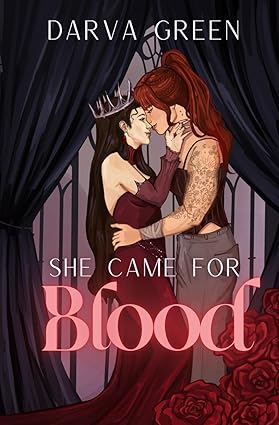
by Darva Green
An Emotional Review
★★★★★
“There is no sun or moon. There is only you.”
The Weight of Remembering
Some love stories begin with a first meeting. This one begins with a memory — one that only half of the couple can access. And that, right there, is the open wound at the heart of Darva Green’s She Came for Blood, the third entry in the Dreamers & Demons: Sapphic Monsters series, and by almost every account, the most devastating entry yet.
Marzanna remembers everything. That is her gift and her curse in equal measure. She has loved Anna across centuries, has watched her die, has survived the aftermath of that loss in ways that carve a person hollow. She has spent lifetimes waiting for a soul that keeps returning without knowing it has ever been here before. And now Anna is back — with blood on her face and hate in her eyes, intending to bring the vampire queen down. Just as soon as she can stop thinking about how much she wants to stay.
Marzanna is the one who remembers. Centuries of it. She remembers the first Anna, the first loss, the prophecy like a splinter under the skin: watching her true love die three times. She carries love and grief as if they’re the same blade—one edge cutting forward, one backward.
Her love isn’t soft; it’s heavy. It’s possessive, desperate, and deeply, painfully patient. Reviews often praise her as a “feral romantic,” a terrifying queen who is, at her core, just a woman who has been waiting too long for the same soul to come back to her. She’s powerful in every way that matters except the one that counts most: she can’t force Anna to remember.
And that’s the cruelty of it—Marzanna could compel, manipulate, reveal everything. But she doesn’t want an echo; she wants recognition. She wants Anna to arrive at that love on her own, in this life, in this body, with this will. That restraint is where her love stops being monstrous and becomes heartbreakingly human.
Anna, for her part, remembers nothing.
The Heartbreak of Being the One Who Remembers
What Darva Green understands, more than most writers working in this genre, is that the tragedy here does not belong to Anna. Anna’s amnesia is a loss, yes — but it is a clean one, blissfully unaware of itself. The tragedy belongs entirely to Marzanna, who must stand across from the woman she has loved and buried and grieved more than once, and pretend, gently, patiently, that she is not already terrified.
Because Marzanna wants Anna to remember on her own. She will not tell her. She will not explain. She will not offer the comfort of context or shared history, because love handed over on a silver platter is not love freely chosen. And Marzanna has waited long enough — centuries long enough — to know the difference.
But underneath that patience lives something she will not name aloud: she does not know if she can survive losing Anna again. The first death hurt. The ones after carved something out of her that has never grown back. And now, with Anna standing in the same room, breathing the same air, falling toward her the same way she always falls — Marzanna is faced with the most unbearable question she has ever had to answer.
Is love worth what it costs to love again?
The Courage of Falling Fresh
Anna is not simply the amnesiac half of a fated pair. She is a woman who falls in love genuinely, without the safety net of memory, without precedent, without the knowledge that she has done this before and how it ended. She chooses Marzanna fresh. And that, in its own way, is a different kind of bravery.
We, as readers, are watching from both sides simultaneously. We know what Anna is stepping back into. We know the prophecy — that she will watch her true love die three times before joining them in death. We know the weight of what is being walked toward, even as Anna herself walks toward it open-eyed and unaware. We hold our breath for her. We grieve for Marzanna. And somehow, impossibly, we root for both of them anyway.
Readers who weren’t expecting to get attached found themselves worrying for Anna, nearly crying, and ultimately — gratefully — happy for her. There is something about a love story told across lifetimes that strips away the cynicism a reader might otherwise carry into the room. You stop protecting yourself from the ending. You just want them to have it.
The Verdict
She Came for Blood is a book about what it costs to love someone who doesn’t remember you. It is about the patience of the one who carries all the memories, and the unknowing courage of the one who doesn’t. It is about a vampire queen standing at the threshold of her own heart, centuries of grief at her back, and asking herself: do I dare?
Darva Green answers that question with everything she has. And by the last page, worn down and grateful, so do you.


